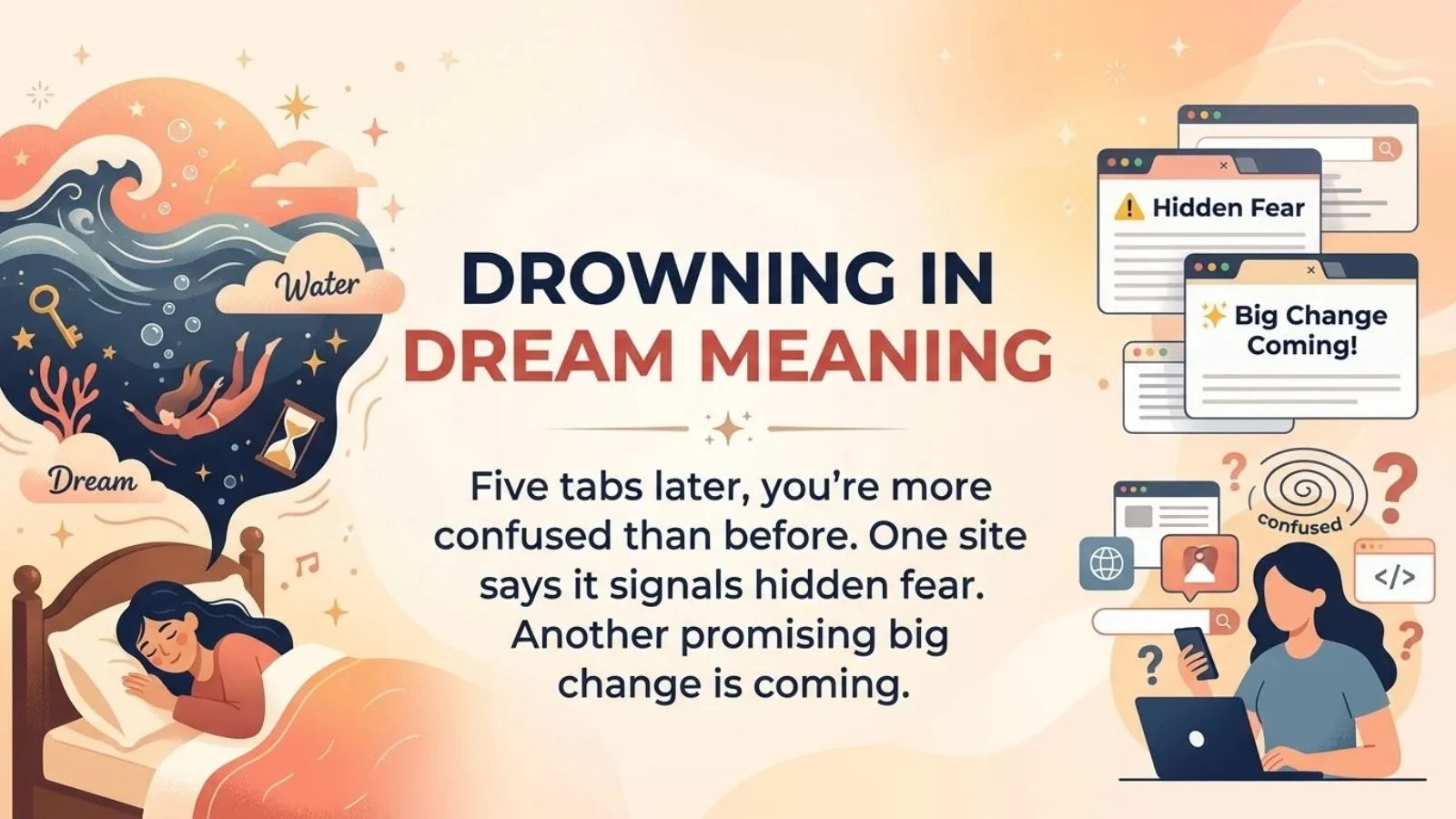
In short, the drowning in dream meaning is about feeling overwhelmed — water rising around you often reflects emotions, pressure, or a situation in waking life that feels out of control. It’s 3 a.m. You wake with your heart pounding. In the dream, water was rising around your ankles, then your waist, then your chest. You grab your phone, still half asleep, and type: what does it mean to dream about drowning?
Five tabs later, you’re more confused than before. One site says it signals hidden fear. Another promising big change is coming.
A third suggests someone close to you is hiding something. All of them sound certain, and none of them agree.
Dream interpretation has never been easier to find or harder to trust. We’re surrounded by dream dictionaries, viral videos, and apps that claim to decode every symbol.
But the answer was never in a list. In this article, we’ll look at how we got here, what science actually says, and how to understand your dreams without losing yourself in them.
How Dream Interpretation Got Here
Not long ago, if you wanted to understand a dream, you asked a friend, a relative, or maybe a therapist. Today, you ask the internet, and the internet answers instantly, endlessly, and with total confidence.
Dream dictionaries have moved online and multiplied. Websites built to capture “dream meaning” searches publish thousands of entries, each promising to explain a snake, a tidal wave, or a lost tooth. TikTok and Instagram interpreters turn dreams into thirty-second verdicts. AI-powered apps will analyze your dream in seconds and hand back a polished explanation.
This flood spreads for understandable reasons. Dreams are intensely personal, yet hard to talk about, so a stranger’s answer feels safer than an awkward conversation. Uncertainty is uncomfortable, and a clear meaning feels like relief. Search-driven content also rewards bold, simple claims over honest ones. “It depends” doesn’t get clicks, so it rarely gets written.
The result is a strange contradiction. The same symbol can mean opposite things depending on which page you land on. Water might represent emotional cleansing on one site and impending disaster on another. When every source speaks with authority and none of them agree, authority stops meaning much.
The real cost isn’t just inaccuracy. It’s overwhelming. Each new interpretation adds another possibility to weigh, another worry to consider, another reason to doubt your own instincts. More meanings don’t produce more clarity. They bury it.
A Short History of Dream Interpretation

People have been trying to read dreams for as long as they have been recording anything. Clay tablets from ancient Mesopotamia treat dreams as omens for kings. Egyptian scribes compiled dream books that paired images with predicted outcomes. In Greece, the sick slept in temples dedicated to Asclepius, hoping a dream would show them the cure.
In the second century, a Greek writer named Artemidorus produced the Oneirocritica, one of the first great dream manuals. Yet even he cautioned that the same dream could mean different things depending on the dreamer’s occupation, status, and circumstances. It’s a strikingly modern idea, buried in a very old book.
Across cultures, dreams were usually treated as messages from gods, ancestors, or the future. Islamic tradition distinguishes true dreams from ordinary ones, and a long scholarly tradition of interpretation grew up around it. South Asian traditions likewise recorded dreams as omens, good and bad.
Then came Sigmund Freud. In The Interpretation of Dreams (1899), he argued that dreams are disguised wishes, with a surface story hiding a deeper meaning. Carl Jung, his former collaborator, disagreed. He saw dreams as the mind’s way of balancing itself, using symbols that were part personal and part shared across humanity.
What’s striking is how little these thinkers agreed. Egyptians, Greeks, Freud, and Jung each offered a different key to the same lock. The best of them, though, kept returning to one point: a dream cannot be separated from the person who had it.
What Science Actually Says
Modern sleep research has learned a great deal about dreaming, though not nearly as much as dream dictionaries pretend. We dream most vividly during REM sleep, when the brain is highly active, though dreams also occur in other sleep stages. Most of them are forgotten within minutes of waking.
Researchers have proposed several theories, and none has won out. Some suggest dreaming helps consolidate memories. Others argue it helps regulate emotions, letting us rehearse difficult feelings in a safe space. Threat simulation theory proposes that dreams evolved to practice responding to danger. Activation-synthesis theory, an early challenger to Freud, suggested dreams are the brain’s attempt to make sense of random neural signals, a view later revised to give more weight to meaning.
What does have solid support is the continuity hypothesis: dreams tend to reflect our waking concerns, emotions, and recent experiences. If you’ve been stressed about work, you’re more likely to dream about missed deadlines than mystical omens.
What lacks support is the idea of fixed, universal symbol meanings. Studies do show that certain themes are widely shared, including falling, being chased, arriving unprepared for an exam, and losing teeth. But frequency is not the same as meaning. Many people dreaming about the same thing doesn’t mean it signals the same thing for all of them.
Dream science remains unsettled, and honest researchers say so. Nobody can credibly claim to decode your particular dream from a symbol list. But science does offer something useful: a reason to look at your own life first, because that’s where dreams most reliably point.
Why Generic Meanings Backfire
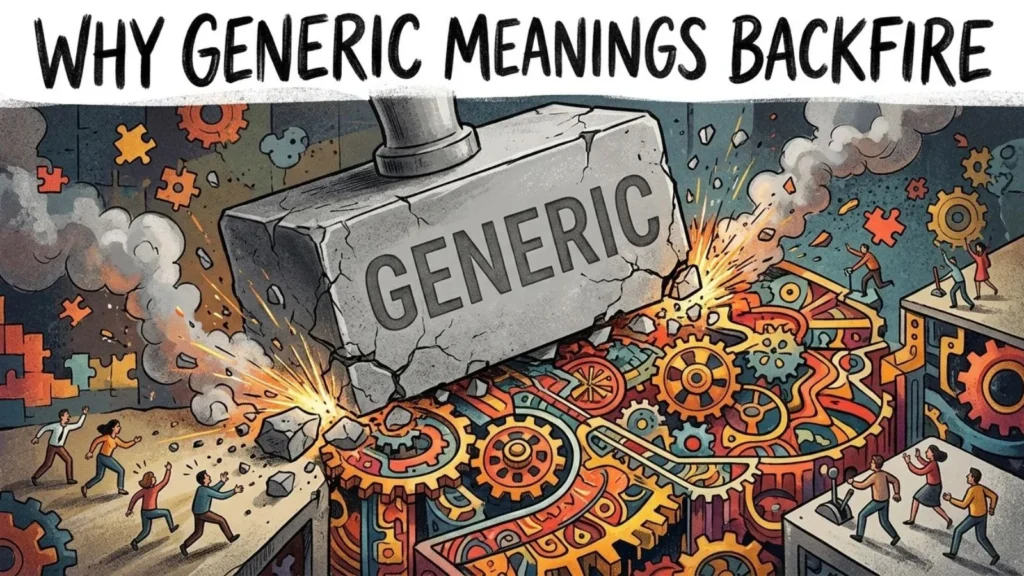
If dream dictionaries can’t tell you what your dream means, why do they feel so convincing? Part of the answer lies in how our minds work.
Confirmation bias is the first culprit. When a list offers five possible meanings, you tend to settle on the one that matches what you already fear or hope. The dictionary didn’t reveal anything. It reflected you back at yourself.
The Barnum effect does the rest. Vague statements like “you are facing change and uncertainty” feel deeply personal, yet they apply to almost everyone. A dream reading that fits everyone doesn’t really fit you.
Generic meanings can also amplify anxiety. A dream about a car crash is unsettling enough. Reading that it predicts a death or a betrayal can leave you more stressed than the dream ever did.
Then there’s the quieter cost: outsourcing your own insight. Every time you hand the job to a list, you skip the most useful question, which is what this image means to you.
Consider a drowning dream. A competitive swimmer might see it as pre-race nerves. Someone grieving may recognize the weight of loss. A person about to move across the world might feel the pull of an overwhelming transition. The same symbol points in three entirely different directions, and no dictionary entry could tell them apart.
The Water Motif: Why Drowning Dreams Make a Perfect Case Study
Few dream images are as common or as emotionally charged as water. Calm seas, rising floods, and sinking beneath the surface show up in dream reports across cultures and ages. Drowning dreams in particular tend to wake people with a jolt, which may be why they send so many of us searching for answers.
The competing readings are easy to find. Water can stand for overwhelming emotion, grief, or a sense of losing control. It can also symbolize cleansing, rebirth, or immersion in something new. Sometimes it means nothing more than a stressful week.
Different lenses produce different answers. A psychological reading might connect water to the unconscious or to feelings you’ve been avoiding. A spiritual or religious tradition may treat it as purification or a crossing into change. A cultural lens asks what water means where you grew up: a source of life, a threat, a sacred river, or a place for holiday swimming.
There is also a plainer explanation worth considering: the body. Trouble breathing, a blocked nose, an awkward sleeping position, or a sleep disorder such as sleep apnea can all shape what you dream. A dream of struggling to breathe underwater may partly reflect a body struggling to breathe in bed.
None of these explanations cancels the others. That’s the point. Water is a prompt, not an answer, and what it prompts depends on who is dreaming. So how do you read a dream without drowning in its possible meanings? That takes a method.
A Better Approach: Staying Afloat
You don’t need a dictionary to understand a dream. You need a method, and a patient one. Here’s a simple approach.
1. Capture first, interpret later. Write the dream down the moment you wake, before analyzing anything. Fragments count. Interpretation too early tends to rewrite the memory.
2. Start with feeling. Ask what the dominant emotion was: fear, grief, curiosity, relief. Emotion is often the most reliable clue, and it’s something only you can report.
3. Check your day. What happened in the last day or two? What has been quietly sitting on your mind? Dreams tend to borrow from recent life.
4. Free-associate. Take one element, such as the water, a person, or a room, and write down whatever it brings to mind. Your associations matter more than any symbol list.
5. Look for patterns. One dream is a snapshot. Recurring themes, people, or settings across several weeks tell a fuller story.
6. Hold interpretations loosely. Treat each idea as a question to test against your life, not a verdict. If it doesn’t ring true, let it go.
7. Consider the body. Poor sleep, caffeine, alcohol, illness, and some medications can make dreams more vivid or disturbing.
8. Decide whether it needs action. Most dreams don’t. Some point to something worth journaling about or discussing with someone you trust.
Your Practical Toolkit

A method works best with a few simple tools. Here’s how to set yourself up.
Build a dream journal. Keep a notebook or a notes app within arm’s reach of your bed. A simple template is enough: date, key images, dominant emotions, what was happening in your life, and your own best guess at what it might mean. Keep it short. A journal you’ll actually use beats an elaborate one you abandon.
Improve your recall. A consistent sleep schedule helps, since irregular sleep tends to fragment dreams. Before bed, tell yourself you’ll remember. On waking, stay still for a moment with your eyes closed, because movement and the phone screen can scatter the memory. Write fragments rather than waiting for the full story. The rest often follows as you write.
Use dictionaries wisely. A dream dictionary can be a useful idea generator when you’re stuck. Treat its entries as prompts to consider, never as authorities.
Use AI tools carefully. AI can help you brainstorm questions to ask about a dream or notice patterns in your journal. It cannot know your life, so don’t expect a definitive answer from it.
Share your dreams. Talking with a trusted friend can open up new angles. A good listener asks open questions, such as “How did that feel?”, rather than announcing what your dream means.
When to Take Dreams More Seriously
Most dreams are harmless, even when they’re strange or unsettling. But a few patterns are worth taking seriously, not because of what the dream symbolizes, but because of what it may say about your sleep and well-being.
Frequent or intense nightmares. An occasional bad dream is normal. Nightmares that occur several times a week, or that feel as vivid and frightening as real events, deserve attention.
Dreams tied to trauma. If your dreams replay a frightening or painful experience, your mind may be struggling to process it. This is common after trauma, and it is something a mental health professional can help with.
Disrupted sleep or daily life. If you dread going to bed, wake repeatedly, or feel exhausted and anxious during the day because of your dreams, the problem has moved beyond curiosity.
Possible sleep disorders. Acting out dreams physically, night terrors, or waking up gasping for air may point to a sleep disorder such as sleep apnea or REM sleep behavior disorder. These are medical issues, not messages from the unconscious.
Frequently Asked Questions
Do dreams mean anything?
Often, yes, but not in the way dictionaries suggest. Research supports the idea that dreams reflect your emotions, concerns, and recent experiences. What they don’t offer is a fixed code that works the same for everyone.
Are dream dictionaries accurate?
Not reliably. Different dictionaries give conflicting meanings for the same symbol, and none can account for your personal history or culture. Use them as idea generators, not authorities.
Do dream symbols have universal meanings?
No solid evidence says they do. Themes like falling, being chased, or losing teeth are common across many people, but being common doesn’t make them mean the same thing for everyone.
Why do I forget my dreams?
Dream memories fade quickly, usually within minutes of waking. Moving around, checking your phone, or waking suddenly can erase them faster. Staying still and writing down fragments right away helps.
Why do I keep having the same dream?
Recurring dreams often track an ongoing worry, stress, or unresolved situation in waking life. When the circumstances change, the dream often does too. Persistent, distressing repeats are worth discussing with a doctor or therapist.
What does it mean to dream of drowning but then being rescued?
Being rescued in a drowning dream often marks the turning point — help, relief, or your own resilience arriving in time. It can mean a stressful situation is easing, or that support is closer than you think. Spiritually, it can be read as a reminder that feeling overwhelmed is not the end of the story, and that reaching out for help is part of staying afloat.
Related Dream Meanings
- Flood in Dream Meaning: What Your Emotions Are Telling You
- Tsunami Dream Meaning
- Ocean Dream Meaning
Conclusion:
This time, you put the phone down. You pick up a notebook instead and write what you remember: the water, the dark, the feeling of your chest tightening. Then you ask the questions that matter. What was the strongest emotion? Fear, mostly, and a sense of being unable to keep up. What happened yesterday? A packed schedule, a deadline you’ve been avoiding, a conversation you haven’t had yet. What does water mean to you? For you, maybe it’s calm on some days and overwhelming on others.
Suddenly the dream isn’t a prophecy or a warning. It’s a mirror, and a fairly honest one. It may be telling you that you feel stretched thin. It may be telling you nothing at all. Either way, you arrived at that thought yourself, and it fits your life in a way no dictionary entry could.

Deirdre Barrett is a psychologist, dream researcher, and author known for studying dreams and the human subconscious. Her work explores dream meanings, emotions, and sleep psychology.
At DreamHatchs.com, we share insights inspired by dream research to help readers better understand their dreams.







1 thought on “Drowning in Dream Meaning: Stop Googling, Start Understanding”