You wake up with your heart pounding. For a few seconds, you aren’t sure whether it really happened.
In the dream, someone was killed, maybe by you, maybe in front of you, maybe it was you. The images linger, and so does the guilt, fear, or confusion.
If that sounds familiar, you’re not alone. Murder dreams are far more common than most people admit, and they rarely mean what they seem to.
Dreams speak in symbols and emotions, not literal events, which is why a violent scene can reflect stress, anger, change, or loss rather than any hidden desire.
In this guide, you’ll learn what murder dreams mean, how different scenarios are interpreted, what psychology says, and when to seek support.
This guide explores the murder dream meaning — why these dreams happen, what the different roles and scenarios reveal, and when they deserve attention.
Why Do We Dream About Murder?
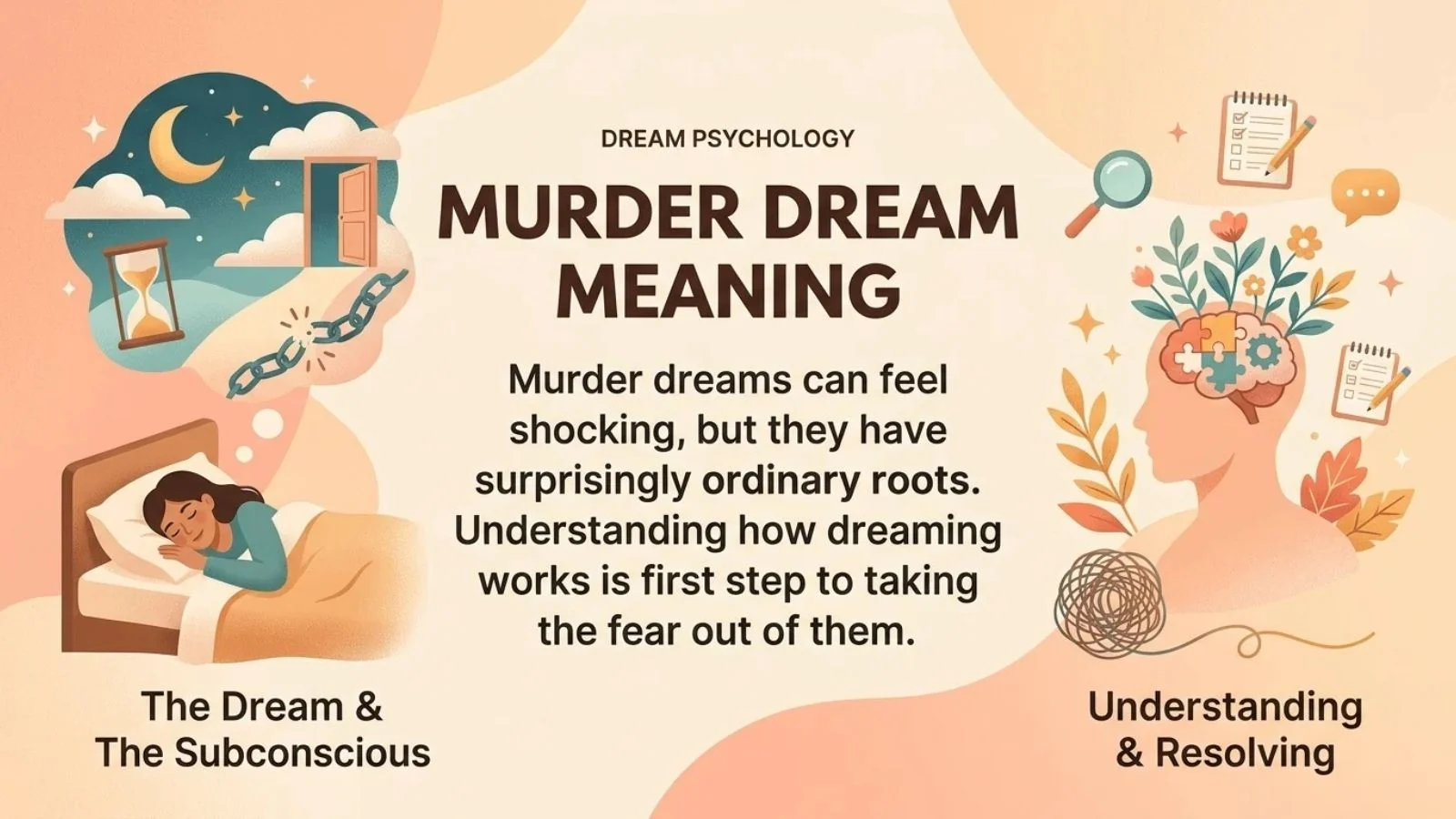
Murder dreams can feel shocking, but they have surprisingly ordinary roots. Understanding how dreaming works is the first step to taking the fear out of them.
How the dreaming brain works. Most vivid dreams happen during REM sleep. During this stage, the amygdala, the brain’s emotional center, is highly active, while the prefrontal cortex, which handles logic and judgment, is quieter. The result is intense feeling without much reasoning, which is why dreams can seem bizarre yet emotionally real.
Emotions, not events. Because dreams run on emotion, violence often acts as a symbol. Murder can represent anger, an ending, a loss of control, or a part of your life you want to change. The dream is rarely about death itself.
Common triggers include:
- Chronic stress, anxiety, or burnout
- Suppressed anger or unresolved conflict
- Major life changes such as a breakup, job loss, or move
- Grief and trauma
- Violent movies, true crime, news, or video games before bed
- Certain medications, alcohol, or sleep disorders that make dreams more vivid
Researchers have also proposed that dreams may help us rehearse threats or process the day’s worries. Whatever the exact purpose, a murder dream is usually your mind working through something real in your waking life, not predicting the future or revealing a dark secret.
Being killed in a dream is frightening, but it rarely points to real danger. In most cases, a dream of being killed reflects the end of a habit, a relationship, or a version of yourself that no longer fits — the mind uses the image of death to mark a change. So if you were killed in a dream, ask what part of your life is ending, rather than fearing what might happen next.
Murder Dreams by Role: Who Are You in the Dream?
Your role in the dream often shapes its meaning. Ask yourself whether you were the victim, the killer, the witness, or the person trying to stop it.
You are the victim. Being murdered in a dream usually points to powerlessness. You may feel threatened, overwhelmed, or controlled by a person, a job, or a situation. The dream may also reflect a fear of losing control or of something in your life “dying,” such as a relationship or sense of security.
You are the killer. This is the most disturbing version for many people, yet it rarely signals violent intent. More often, it reflects suppressed anger, frustration, or a wish to end a habit, role, or relationship. It can also bring guilt or a fear of your own impulses. Feeling horrified in the dream is a sign your values are intact, not absent.
You are the witness. Watching a murder can mean you feel like a helpless observer in your own life. It may point to a problem you’ve noticed but haven’t acted on, or a conflict you feel unable to influence.
You are trying to stop a murder. Intervening suggests a protective instinct. You may feel responsible for someone’s wellbeing or want to step into a situation that is out of your hands.
Murder Dreams by Victim or Perpetrator

Who dies, or who kills, adds another layer of meaning. These are the most commonly searched scenarios.
Killing a family member or partner. This rarely signals hatred. It often reflects built-up frustration, a feeling of being controlled, or a wish to change the dynamic between you.
Killing a friend or coworker. Usually tied to resentment, competition, or tension you haven’t voiced.
Killing an ex. Often a symbol of closure, letting go of the past, or ending the hold that relationship still has on you.
Killing a stranger. Strangers often represent a part of yourself, a trait, habit, or role you want to be rid of.
Killing a child or baby. Though deeply upsetting, this typically symbolizes the end of a project, a phase of life, or a vulnerable part of yourself, not harming a real child.
Killing an animal. May reflect suppressing instincts, or feeling you must control a “wild” side of yourself.
Being killed by someone you know. Suggests you feel threatened, betrayed, or overpowered by that person or what they represent.
Being killed by a stranger. Often points to a vague, unnamed fear or anxiety.
A loved one being murdered. Usually reflects fear of loss or worry about their wellbeing, not a premonition.
Killing yourself in a dream. Often symbolizes a desire to end a part of your life or identity rather than a literal wish to die. If thoughts of self-harm follow you into waking life, please reach out to a mental health professional or a local crisis line.
Murder Dreams by Method and Setting
The details around the act, such as the weapon, the place, and what happens afterward, can add nuance to your dream’s meaning.
Weapons and methods
- Gun: Quick, distant, impersonal anger, or a wish for decisive control.
- Knife: Close, personal conflict, often tied to betrayal or sharp words.
- Strangulation: Feeling silenced, restricted, or unable to express yourself.
- Poison: Slow, hidden resentment, or a toxic situation.
- Drowning: Being overwhelmed by emotion.
- Bare hands: Raw, direct frustration.
Settings
- Home: Tension in family life or in your sense of safety.
- Workplace: Pressure, competition, or burnout.
- School: Old insecurities or feeling judged.
- Dark forest or isolated place: Uncertainty, or feeling alone with a problem.
- Crowded public place: Worry about being exposed or judged by others.
What happens afterward
- Blood: Intense emotion or a sense of life force being drained.
- Hiding a body: Concealing a secret, mistake, or feeling you aren’t ready to face.
- Getting caught: Fear of consequences or of being exposed.
- Escaping or covering up: Avoidance of a problem you know needs attention.
Your emotions matter most. Guilt may point to unresolved conflict, relief to a wish for freedom, numbness to emotional exhaustion, and terror to deep anxiety. These symbolic readings are not fixed rules. Your own associations with a weapon or place often matter more than any dream dictionary.
Special Scenarios People Search For

Some murder dreams follow familiar patterns that raise their own questions. Here are the most common.
Being chased by a murderer. Usually a sign you’re avoiding a problem, fear, or difficult emotion. The chaser often represents whatever you least want to face.
Hiding from a killer. Suggests you feel vulnerable or are trying to stay out of a stressful situation rather than confront it.
Getting away with murder. May reflect guilt over something you feel you’ve escaped accountability for, or relief at ending something without consequences.
Going to prison for murder. Often points to feeling trapped, judged, or punishing yourself for a mistake.
Dreaming of a serial killer. Can symbolize a persistent, looming fear or a threatening force in your life that feels unpredictable.
Recurring murder dreams. Repeating dreams usually mean an issue remains unresolved. The more the dream returns, the more it’s worth exploring what stress, conflict, or trauma it may be tied to.
Murder dreams during pregnancy. These are very common. Hormonal changes, anxiety about the future, and unusually vivid dreams all play a role. They typically reflect worries about change and responsibility, not a desire to harm anyone.
Murder dreams after a breakup or loss. Grief and anger often surface in dramatic imagery. The dream may be processing pain, rejection, or the “death” of a relationship.
Psychological Perspectives

Psychologists have long tried to explain why we dream, and each school offers a different lens on violent dreams.
Freud: repressed desires. Sigmund Freud believed dreams express hidden wishes and aggression that the conscious mind suppresses. In this view, a murder dream might reveal anger you haven’t acknowledged.
Jung: the shadow self. Carl Jung saw dreams as messages from the unconscious. Killing in a dream may represent confronting the “shadow,” the traits you reject in yourself, or a need to integrate them.
Gestalt: every figure is you. Gestalt therapy suggests every character in a dream represents part of the dreamer. The victim and the killer may be two sides of one inner conflict.
Threat Simulation Theory. Finnish researcher Antti Revonsuo proposed that dreams evolved to rehearse dangerous situations, which would explain why threatening scenes are so common.
Continuity Hypothesis. Associated with G. William Domhoff, this idea holds that dreams reflect our waking concerns, so a murder dream often mirrors current stress or conflict.
Activation-Synthesis. This theory suggests the brain weaves random neural signals during REM sleep into a story, meaning some dreams may have little hidden meaning at all.
| Theory | Core idea |
| Freud | Dreams reveal repressed wishes |
| Jung | Dreams integrate the shadow self |
| Gestalt | Every figure is part of you |
| Threat Simulation | Dreams rehearse danger |
| Continuity | Dreams reflect waking life |
| Activation-Synthesis | Dreams are the brain’s story-making |
No single theory explains every dream, and researchers still debate the answers. Most modern approaches agree on one point: murder dreams are rarely literal.
Cultural, Religious, and Spiritual Interpretations

Across history, people have read dreams as more than random brain activity. These traditions offer different perspectives, and they are best understood as beliefs, not proven facts.
Western folk dream dictionaries. Popular dream books often treat murder as a symbol of an ending, a transformation, or a warning about conflict. Killing in a dream may signal the end of a phase rather than a literal threat.
Islamic dream interpretation. In Islamic tradition, dreams are classified, and scholars historically distinguished meaningful dreams from those driven by stress or the mind’s own chatter. Interpretations of killing vary widely among scholars, and many advise consulting a knowledgeable, trusted person rather than relying on generic lists.
Christian perspectives. Some Christians see dreams as a space for reflection or conscience. A murder dream may prompt thoughts about anger, forgiveness, or unresolved guilt, rather than being read as a literal prophecy.
Eastern views. In Hindu and Buddhist thought, dreams often reflect the mind’s attachments, fears, and desires. Violence may symbolize inner struggle or the need to let go. Traditional Chinese dream interpretation, by contrast, has historically linked dream imagery to balance, fortune, or the state of one’s inner energy.
Indigenous and ancestral views. Many Indigenous cultures regard dreams as meaningful communication, sometimes from ancestors or the spirit world, and treat them with community or ritual significance. Interpretations differ greatly between nations and peoples.
A balanced approach. These traditions often share one theme: a murder dream seldom means what it appears to. Whether you view dreams spiritually, psychologically, or both, treat them as invitations to reflect, not as fixed verdicts or predictions.
Murder Dreams and Mental Health

Most murder dreams are harmless, but sometimes they connect to deeper issues worth understanding.
PTSD and trauma. Trauma-related nightmares often replay or echo frightening events. They tend to be intense, repetitive, and linked to waking distress.
Anxiety and depression. Both conditions can increase nightmares. Violent imagery may reflect overwhelming worry, hopelessness, or suppressed anger.
Nightmare disorder. When frightening dreams happen frequently and cause distress or daytime fatigue, they may qualify as a clinical sleep problem that is treatable.
Sleep disorders. REM sleep behavior disorder, where people physically act out dreams, and sleep paralysis can make violent dreams feel more vivid or frightening.
Intrusive thoughts and OCD. Dreams of harming loved ones can be especially distressing for people prone to intrusive thoughts. These dreams do not predict behavior, and the distress they cause is often a sign of how deeply the person cares.
Warning signs it’s time to get help:
- Dreams recur often or are getting worse
- You dread going to sleep
- You feel distressed or anxious during the day
- The dreams are tied to a past trauma
- Sleep is consistently disrupted
Support options. A doctor or therapist can help with approaches such as cognitive behavioral therapy for insomnia (CBT-I) and imagery rehearsal therapy. Sometimes a medication review also helps, since some drugs affect dreaming.
Myths and Misconceptions

Murder dreams are surrounded by fear and misunderstanding. Here are the most common myths, and what is closer to the truth.
Myth: “I’m secretly violent.”
Dreaming about violence does not reveal a hidden violent nature. Dreams run on emotion and symbolism, and the horror most people feel in the dream is a sign their values are intact.
Myth: “It’s a premonition.”
There is no scientific evidence that dreams predict the future. A dream about a loved one being harmed usually reflects worry or fear of loss, not something that will happen.
Myth: “It means I want that person dead.”
Rarely. Killing someone in a dream more often symbolizes frustration with a situation, a dynamic, or a part of the relationship you wish could change.
Myth: “Only disturbed people have these dreams.”
Violent dreams are common across all ages and backgrounds. Studies of dream content consistently find that aggression and threat appear in many people’s dreams, especially during stressful periods.
Myth: “Every symbol has one fixed meaning.”
Dream dictionaries can be useful starting points, but your own feelings and life circumstances shape what an image means to you.
Myth: “If I ignore it, it will go away.”
Occasional dreams often fade on their own. But recurring ones may signal unresolved stress, and exploring them can bring relief.
Myth: “I should feel guilty.”
Guilt after a dream is understandable, but you are not responsible for what your sleeping mind produces. Dreams are not actions or choices.
How to Interpret Your Own Murder Dream: A Step-by-Step Framework

You don’t need to be an expert to explore your dream. This simple process helps you move from fear to understanding.
1. Write it down immediately. Dreams fade fast. Record everything you remember, including people, places, weapons, and the ending, even if it seems random.
2. Identify your strongest emotion. Was it fear, guilt, anger, relief, or numbness? The feeling often points to the real issue more than the plot does.
3. Decide who or what each character represents. Ask what the victim, the killer, or the setting reminds you of. Remember the Gestalt idea: each figure may be a part of you.
4. Connect it to your waking life. Consider recent stress, conflicts, losses, or changes. Dreams often echo the past few days or weeks.
5. Look for patterns. Track your dreams over time. Repeated themes, people, or emotions reveal what remains unresolved.
6. Decide whether anything needs action. Sometimes the answer is a difficult conversation, a boundary, or more rest. Other times, simply understanding the dream is enough.
Free dream journal template (copy and use):
- Date:
- Dream summary:
- My role (victim, killer, witness, helper):
- Strongest emotion:
- Who or what might each figure represent:
- What’s happening in my life right now:
- Possible message or action:
Keep the journal by your bed and write before checking your phone. Over a few weeks, patterns usually become clear, and the dreams often feel less frightening once you understand them.
How to Stop Disturbing or Recurring Murder Dreams

You can’t fully control your dreams, but you can make disturbing ones less frequent and less distressing.
Build a steady sleep routine. Go to bed and wake up at the same time, keep your room dark and cool, and avoid screens in the last hour before sleep. Poor or irregular sleep often makes vivid dreams more intense.
Watch what you consume. Alcohol, heavy late-night meals, and too much caffeine can disrupt REM sleep. Limit violent movies, true crime, and distressing news close to bedtime.
Manage daytime stress. Since murder dreams often mirror anger and anxiety, regular exercise, deep breathing, meditation, or talking things through can lower the emotional charge you carry into sleep.
Journal before bed. Writing down worries or unresolved conflicts can keep them from surfacing as dramatic dream imagery.
Try imagery rehearsal therapy. This well-studied technique works well for recurring nightmares:
- Write down the dream.
- Change the ending or any part you choose, such as escaping, waking up, or turning the scene into something harmless.
- Rehearse the new version in your mind for 10 to 15 minutes a day.
Over time, the rewritten story can replace the old one.
Review medications. Some antidepressants, blood pressure drugs, and sleep aids can cause vivid or disturbing dreams. Never stop a prescription on your own, but do ask your doctor whether it could be a factor.
Know when to get help. If the dreams persist for weeks, disrupt your rest, or are linked to trauma, a therapist trained in CBT-I or imagery rehearsal can help. These dreams are very treatable.
Frequently Asked Questions
Does dreaming about murder mean I’m a bad person?
No. Dreams reflect emotions and symbols, not your character or intentions. The distress you feel afterward usually shows your values are intact.
Is a murder dream a warning?
There is no scientific evidence that dreams predict events. They more often signal stress, conflict, or worry you are carrying in waking life.
Why do I dream about killing someone I love?
It usually reflects frustration with a situation or dynamic, or a fear of losing that person, rather than a wish to harm them.
Why do I feel guilty after dreaming I killed someone?
Your waking mind judges the dream by real-life standards. Guilt is a normal reaction, but you are not responsible for what your sleeping brain produces.
Why do I keep having the same murder dream?
Recurring dreams often point to unresolved stress, conflict, or trauma. Journaling, stress management, or imagery rehearsal therapy can help.
Can medication cause murder dreams?
Yes. Some antidepressants, blood pressure medications, and sleep aids can make dreams more vivid or disturbing. Talk to your doctor before changing anything.
What does it mean to dream of witnessing a murder but not taking part?
Witnessing a murder without acting in a dream often reflects feeling powerless about a change or conflict around you. It can mean a part of your life is ending — a habit, a relationship, a version of yourself — and you are watching it go. The dream is usually about the ending itself, not about violence or guilt.
Related Dream Meanings
- Killing Someone in a Dream Meaning: What Does It Really Mean?
- Spiritual Meaning of Shooting Someone in a Dream
- Dream of Death Meaning
Conclusion
A murder dream can leave you shaken, but it is rarely the sinister message it appears to be. Dreams speak in emotion and symbol, so a violent scene usually reflects stress, anger, fear of loss, or a change you are still processing, not a hidden desire or a prediction.
Pay attention to the details: your role, the people involved, and above all the feelings the dream stirred up.
Those clues can point to what needs attention in your waking life, whether that is a conversation, a boundary, or simply more rest.
Meet these dreams with curiosity, not fear or self-judgment. If they keep returning, disrupt your sleep, or connect to trauma, a therapist or doctor can help, and these dreams are very treatable.
In the end, the murder dream meaning is rarely about violence itself — it is about what your mind is processing: endings, anger, fear, or change.

Ernest Hartmann is a dream researcher and author known for his work on dreams and their meanings.
At DreamHatchs.com, we explore dream symbolism and interpretations to help readers better understand their dreams.








1 thought on “Murder Dream Meaning: Why You Dreamed About Killing or Being Killed”